
Teonanácatl: The Nahua Name for the Sacred Mushroom
Before Western science named psilocybin, the Nahua peoples of central Mexico had a word for the mushroom and a practice that surrounded it. This is what the colonial record shows, what it leaves out, and why the name still matters.
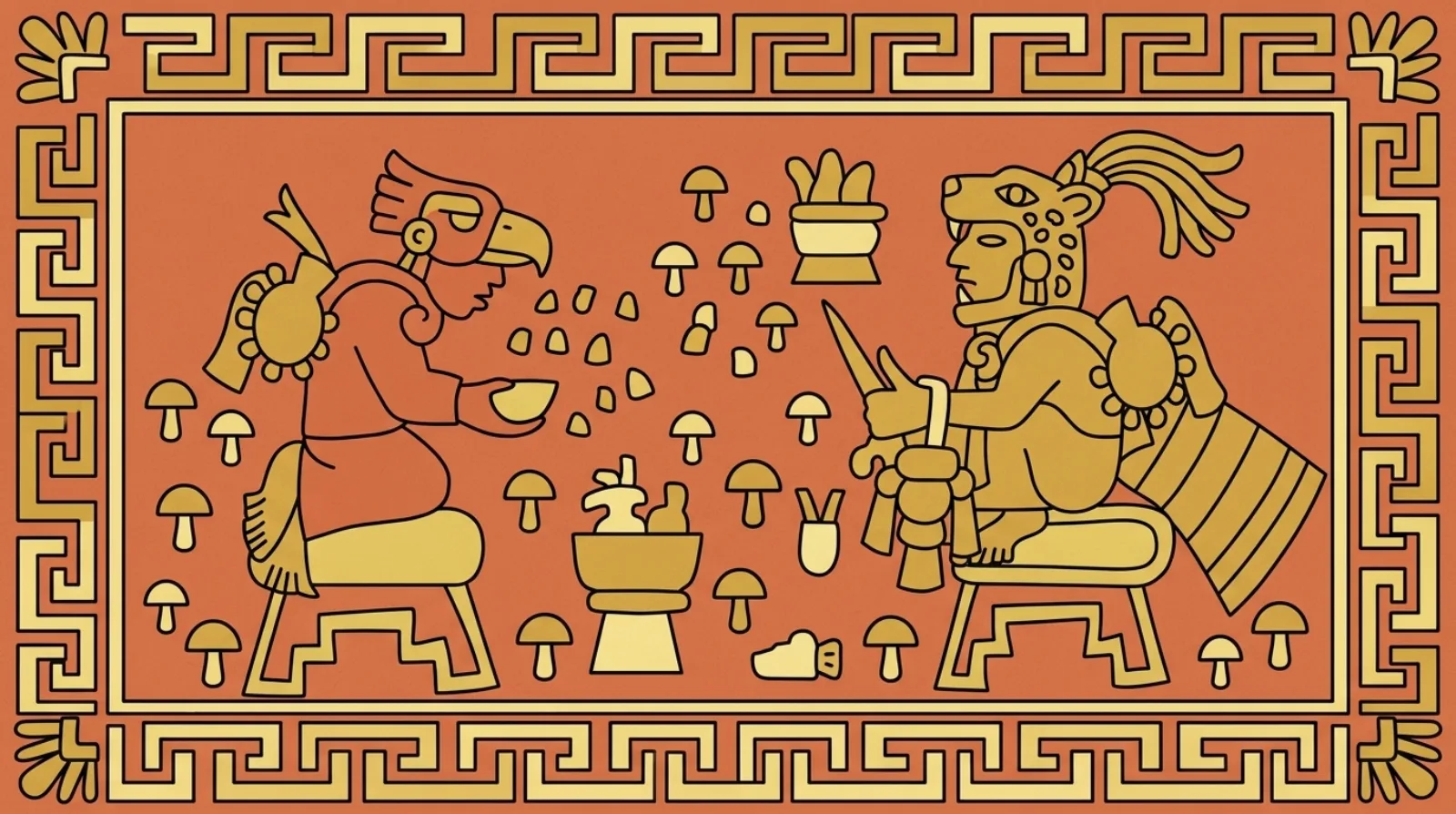
Image: Page from the Florentine Codex, c. 1577. Public domain via Wikimedia Commons.
The word is teonanácatl. It is a Nahuatl word, from the language the Nahua peoples — sometimes called the Aztecs by outsiders — spoke before the Spanish arrived in 1519 and still speak today. The word is usually translated into English as “flesh of the gods,” but that translation is a Western gloss, and like most Western glosses it carries assumptions that the original probably did not.
Before you go any further, the first thing worth saying is that the Nahua are not an ancient people. They are a present-day people. There are roughly 1.7 million Nahuatl speakers alive right now, living mostly in central and southern Mexico. When we talk about teonanácatl in the past tense we should be careful. The language, the communities, and in some places the ceremonial relationship with the mushroom have not disappeared. They were pushed underground, survived five centuries of suppression, and are still here.
This is a short account of what the historical record shows, what it fails to show, and what the name is asking of anyone who picks up a microdose today.
What the Florentine Codex actually says
The primary Western source for pre-Columbian Nahua mushroom use is the Florentine Codex, a twelve-volume encyclopedia of Nahua life compiled by the Franciscan friar Bernardino de Sahagún and his Nahua collaborators between roughly 1547 and 1582, with a final Florentine version completed around 1569. Sahagún worked with Nahua elders and scribes in what is now Mexico City and recorded, in both Nahuatl and Spanish, what those elders told him about their world before the conquest.
The codex describes teonanácatl as a mushroom that was consumed ceremonially, often at feasts, and that produced visions. One well-known passage describes the mushrooms being served with honey at the wedding feast of a merchant, after which the participants “saw many things — some pleasurable, some fearful.” Another passage describes the mushrooms being used by healers and diviners to see the cause of illness or to locate lost objects.
The codex also records that the Spanish ecclesiastical authorities considered the use of teonanácatl heretical. It was named in the Inquisitorial records of the colonial period as a “diabolical” practice. Using it was punished. Over time, explicit ceremonial use of teonanácatl in Nahua communities in the central highlands was driven underground, largely ended, or continued only in altered forms.
The codex is an extraordinary document and the single most important written source we have on pre-conquest Nahua life. It is also not a neutral document. Sahagún was a Franciscan friar whose explicit goal was to learn Nahua religion well enough to replace it. His informants were survivors of a genocidal conquest working under the gaze of the institution that had conquered them. What the codex records is what could be said in that setting, to that listener, in the aftermath of that violence. It is not what the Nahua would have written about themselves if no Spanish friar had ever arrived.
So when we cite teonanácatl from the Florentine Codex, we are citing a tradition whose full depth was never written down, whose ceremonial language was largely lost, and whose surviving record is filtered through the hand of the conquering church. That should shape how confidently we claim to know what the ceremony was.
What the name probably means
Teonanácatl breaks down roughly as teō- (divine, sacred, god-related) + nanácatl (mushroom, or flesh). The translation “flesh of the gods” treats the word as a compound noun. Some Nahuatl scholars have pointed out that teo- in Nahuatl is not quite the same thing as the English “god” — it marks something as sacred, powerful, charged with spiritual weight, in a way that doesn’t cleanly map onto Christian theology. “Flesh of the gods” is a translation a Spanish friar would make, because it slots teonanácatl into the framework of the Eucharist and makes the heresy legible. A more careful translation might be something closer to “the sacred flesh” or “the flesh that carries the sacred.”
The difference matters. “Flesh of the gods” sounds like a substance meant to commune with specific deities — a supernatural food. “The flesh that carries the sacred” is a different idea. It describes a mushroom that was treated as a being in its own right, holding something larger than itself, present for those who came to it rightly.
The Mazatec curanderos a few hundred miles to the south call their mushrooms Los Niños Santos — the Holy Children. That is also a Christianized name, from a tradition that has woven pre-contact ceremony together with Catholicism over four centuries. But the basic posture is consistent across both traditions: the mushroom is not a thing to be used. It is something to be received.
What the ceremony looked like
Here the record is thin. The Florentine Codex describes a feast setting — mushrooms consumed with honey, music, and ritual structure — but it does not record the prayers, the ceremonial language, or the full framing of how a Nahua diviner or healer used teonanácatl. Much of what we would want to know is simply gone, destroyed along with the codices and religious structures the Spanish burned in the first decades of the conquest.
What can be said with reasonable confidence is this: the use was not recreational in the modern sense. It was embedded in specific roles, occasions, and relationships. Diviners used it to answer specific questions. Healers used it to see into illness. Feasts used it to mark an event with sacred weight. No surviving Nahua account treats teonanácatl as entertainment.
The modern practice of walking into a kitchen, pulling out a capsule, and taking a dose on a Tuesday morning because you have a meeting at ten — that is a very different relationship with the mushroom than the ceremonial one. It is not automatically a worse one. It is simply a different one, and the difference deserves honest acknowledgement rather than dressed-up borrowing of ceremonial language that doesn’t belong to the person using it.
What the word is asking of us
If you use the word teonanácatl, or the phrase “flesh of the gods,” or any of the language that comes out of Mesoamerican ceremonial traditions, the basic ask is small and important. It is the difference between borrowing and citing.
Borrowing is when you use the word because it sounds beautiful and ancient and gives your personal practice an air of depth it hasn’t yet earned. Citing is when you use the word because the history is real, the people who carried it are real, and naming that lineage is part of how you engage honestly with what you are doing.
Borrowing extracts. Citing acknowledges.
You don’t have to become a Nahua ceremonialist to take a microdose. You don’t have to pretend you are part of a lineage you aren’t part of. What you can do is know where the word came from, remember what it cost the people who kept it alive, and let that memory sit next to you when you use the medicine. That costs you nothing and it changes the shape of the practice.
Where this leaves a modern practitioner
A microdose taken in a rented apartment in Denver is not a velada. It is not a Nahua ceremony. It is its own thing, and pretending otherwise is a kind of dishonesty the traditions themselves would not respect.
But the word teonanácatl is also a reminder that the molecule you are putting in your body has a five-hundred-year written history and probably a far longer oral one, and that every serious culture that has lived with this mushroom has arrived at the same conclusion: this is a powerful thing, and powerful things are received on their terms, not yours. That conclusion wasn’t arrived at by running clinical trials. It was arrived at by walking with this medicine for generations.
The modern microdoser is not required to reproduce Nahua ceremony. The modern microdoser is invited, by the weight of the word itself, to not be flippant about what they are handling.
Sources and Further Reading
- Sahagún, B. de. (1545–1590). Historia general de las cosas de Nueva España (Florentine Codex), Book 9 and Book 11. Facsimile and English translation: Anderson, A. J. O. & Dibble, C. E. (1950–1982), School of American Research & University of Utah Press.
- Wasson, R. G. (1980). The Wondrous Mushroom: Mycolatry in Mesoamerica. McGraw-Hill.
- Guzmán, G. (2008). “Hallucinogenic Mushrooms in Mexico: An Overview.” Economic Botany, 62(3), 404–412.
- Schultes, R. E., & Hofmann, A. (1979). Plants of the Gods: Origins of Hallucinogenic Use. McGraw-Hill.
- Carod-Artal, F. J. (2015). “Hallucinogenic drugs in pre-Columbian Mesoamerican cultures.” Neurología, 30(1), 42–49.
Related on The Microdose Movement
- Maria Sabina and the Sacred Children of the Mountain — the Mazatec curandera who brought the tradition to the modern world’s attention
- Indigenous Wisdom and the Modern Practice — what we owe the people who kept this alive
- A Brief History of Microdosing — the long arc from pre-conquest ceremony to modern protocol
The Microdose Movement is an educational community, not a medical provider. Nothing in this article is medical advice. Our treatment of Nahua and Mesoamerican traditions is written with respect for living descendants of those traditions and with acknowledgement of the limits of the colonial-era sources we are working from.
