
The Stoned Ape Theory: What the McKennas Actually Proposed and Why It's Still Debated
Terence and Dennis McKenna proposed that psilocybin mushrooms played a role in early human cognitive evolution. The idea is famous, poetic, and not settled. Here is what they actually said, what the evidence supports, and what it doesn't.
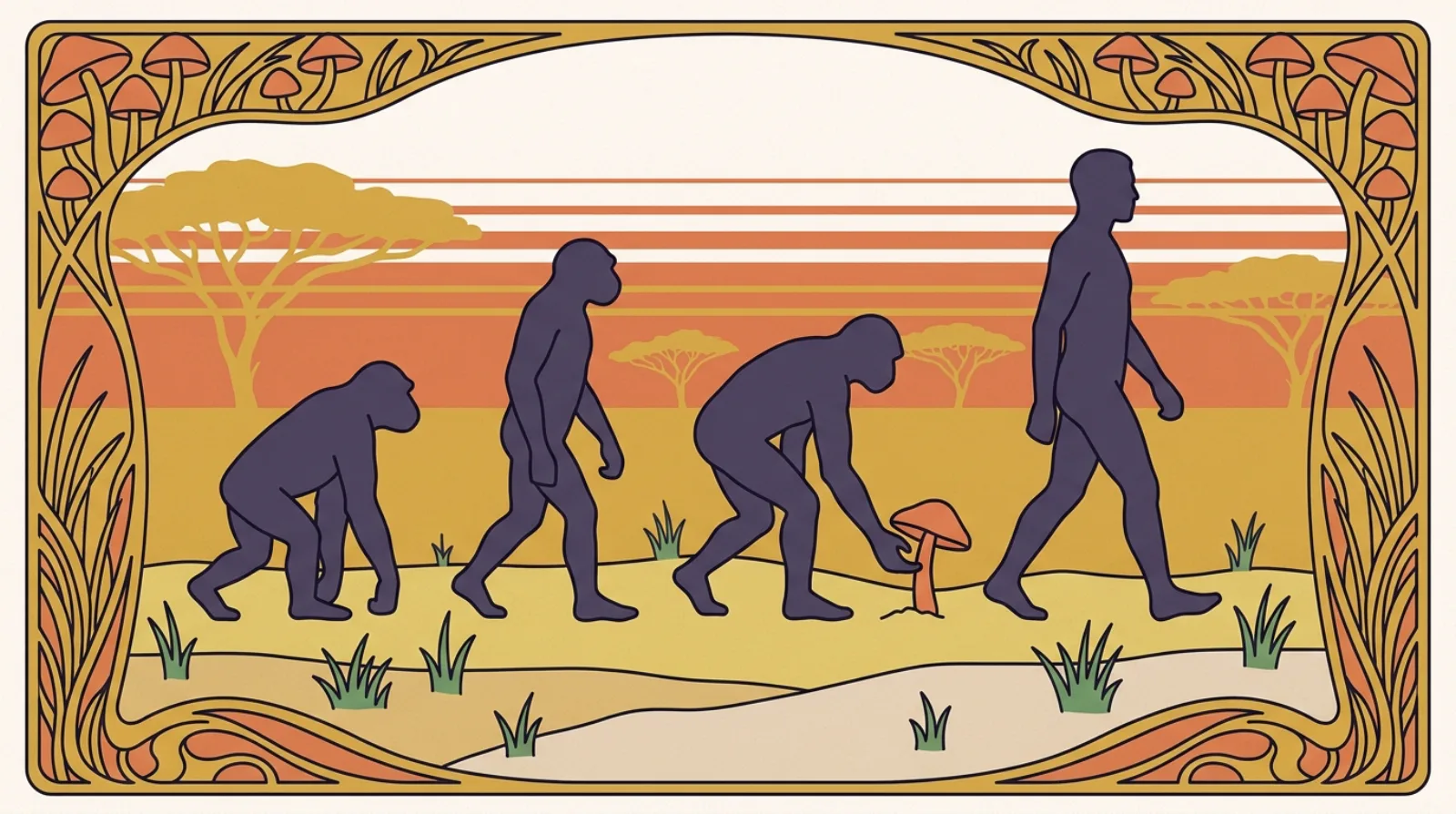
Photo: Terence McKenna, 1999. Jon Hanna, CC BY-SA 3.0, via Wikimedia Commons.
If you spend any time in the psychedelic corner of the internet, you will eventually run into the Stoned Ape Theory. It is one of the most repeated and most misunderstood ideas in the whole cultural conversation about psilocybin. People treat it as settled science or as crackpot nonsense depending on who is speaking, and neither of those readings is quite right.
Here is the honest version: what the theory actually says, who said it, what the evidence for and against it is, and what an intellectually careful person should do with it.
What Terence McKenna actually proposed
The Stoned Ape Theory was popularized by the ethnobotanist and writer Terence McKenna in his 1992 book Food of the Gods, with substantial input from his brother Dennis McKenna, a serious ethnopharmacologist who has spent his career studying psychoactive plants and fungi. The two brothers came at the idea from different directions (Terence as a storyteller and philosopher, Dennis as a working scientist) and the version that reached the public was mostly Terence’s, which is part of why the theory got the reputation it has.
The claim, in its strongest form, goes something like this:
Roughly 100,000 years ago, populations of Homo erectus on the African savanna were following herds of cattle and scavenging from the dung piles of large herbivores. Mushrooms of the genus Psilocybe grow readily on the dung of cattle and other hoofed animals. Early humans would have encountered and consumed these mushrooms. At small doses, psilocybin may have improved visual acuity (useful for hunting). At moderate doses, it may have improved sexual arousal and social bonding (useful for group cohesion). At higher doses, it may have produced the ecstatic, language-rich, boundary-dissolving states that the McKennas believed were the seed of symbolic thought, ritual, and ultimately human language and self-awareness. Psilocybin, in this reading, is one of the catalysts that helped drive the human cognitive explosion.
That is the theory. It is a beautiful story and it is not a proven story. The McKennas themselves, or at least Dennis, have been clear about that.
The parts that are grounded
Let’s separate what is factual from what is speculation.
Grounded: Psilocybe species do grow on the dung of hoofed animals. This is well documented. A mycologist can hand you a field guide that will show you where to find them.
Grounded: Early hominids in the African savannah would have encountered dung piles regularly. They were following herds for meat; they would have seen what grew on the droppings.
Grounded: Psilocybin at very low doses has been shown in a small number of modern studies to have subtle effects on perception, including visual sensitivity. Whether this would have produced a meaningful evolutionary advantage in a hunting context is a separate question that has not been demonstrated.
Grounded: Our species’ cognitive evolution accelerated dramatically during the timeframe the McKennas reference. The emergence of symbolic thought, language, tool specialization, and ritual behavior all appear in the archaeological record during this window. What caused that acceleration is one of the oldest open questions in paleoanthropology.
Grounded: Psilocybin has measurable effects on neural plasticity, and some modern research has begun to explore the idea that psychedelic compounds can promote the formation of new synaptic connections. This research is early, it is mostly in animal models, and its implications for human evolution are speculative, but the basic finding that psilocybin affects brain plasticity is real.
The parts that are speculation
Speculation: That early humans consumed psilocybin mushrooms in meaningful quantities over evolutionary timescales. No direct evidence exists. Mushrooms do not fossilize, and coprolites (ancient feces) from the relevant period have not yielded psilocybin residues because the compound is not stable for that long. The idea is plausible but unprovable.
Speculation: That psilocybin conferred a survival advantage through improved hunting, social bonding, or cognitive performance. Each of these is a proposed mechanism, not a demonstrated one. There is no controlled experiment that could test whether a Homo erectus hunter who ate Psilocybe mushrooms reproduced more successfully than one who did not.
Speculation: That psilocybin is what catalyzed the emergence of language and symbolic thought. This is the most dramatic claim in the theory and the least supported. Language emergence is a notoriously hard problem and there are many competing hypotheses, none of which are settled, and most of which do not require psychedelic mushrooms as an ingredient.
Speculation: That the scale and consistency of this consumption would have been large enough, over enough generations, to shape the course of hominid evolution in a meaningful way. Even if some early humans ate mushrooms some of the time, translating that into selection pressure that actually changed the species is a very large inferential leap.
Where the scientific community lands
Most working paleoanthropologists and evolutionary biologists do not take the Stoned Ape Theory seriously as a mainline account of human cognitive evolution. This is not a conspiracy or an act of prudery. It is because the evidence is thin, the mechanism is speculative, and there are simpler and better-supported explanations for the relevant cognitive shifts, including social complexity, dietary changes (especially cooked meat, associated with Homo erectus and proposed by the biologist Richard Wrangham), and the accelerating feedback loop between tool use and brain size.
That said, a smaller group of researchers has taken the underlying question seriously and tried to put it on better footing. The mycologist Paul Stamets is one. He has proposed a reconsidered version of the theory that focuses on the neurogenic and plasticity-promoting effects of psilocybin as a possible contributing factor, not the prime mover the McKennas proposed, but a potential ingredient in a larger story. Dennis McKenna himself has, in more recent interviews, walked back the stronger claims of the theory while defending the core idea as worth investigating. He has been notably more measured than his brother was.
The honest scholarly position, as of 2026, is: the Stoned Ape Theory in its strong form is not supported by available evidence, but the weaker claim, that psychoactive plants and fungi may have played some role in the cognitive and cultural lives of early humans — is an open and legitimate question. We do not know. We may never know, because the evidence we would need has rotted away.
Why the theory keeps coming back
A good story is hard to kill. The Stoned Ape Theory gives psilocybin a kind of creation myth: the mushroom as co-author of the human mind, the catalyst that bootstrapped our species into consciousness. It is romantic, it is subversive, and it gives people who use these substances a narrative in which their practice is not merely personal but part of a deep pattern in what it means to be human. That is emotionally powerful and it is why the theory has survived even as the scientific case for it has not strengthened.
It is okay to find the story beautiful. It is not okay to cite it as fact. The two postures are different, and the difference is the whole game when it comes to engaging honestly with ideas that are not yet settled.
What an intellectually careful person should do with this
Here is a posture that keeps you out of trouble.
Take the theory seriously as an intellectual artifact. It was proposed by two thoughtful people, one of them a working scientist, and it touches on real open questions in evolutionary biology and neuroscience.
Do not take it seriously as a settled scientific claim. When someone tells you “science has proven that psychedelics made us human,” they are wrong. That is not what the science says. That is what a strong reading of a speculative theory said in a 1992 book.
Hold the weaker version loosely. The idea that early humans, at some points in their history, ate psychoactive mushrooms and had experiences that mattered to them is plausible. It does not require evidence beyond what we already have: mushrooms exist, humans existed, curious humans eat things. What that experience shaped in the long run is the question that cannot be answered from where we currently stand.
Separate the theory from the practice. Whether you microdose tomorrow or not should have nothing to do with whether Terence McKenna was right about Homo erectus. Your reasons for engaging with this medicine should rest on something you can examine directly: your own experience, the contemporary evidence, the integrity of your intentions. Not on a story about the deep past that we cannot verify.
The Stoned Ape Theory is, at best, a provocation worth sitting with. It is not a foundation to stand on. Standing on it will not make you more grounded in this practice; it will make you less.
Sources and Further Reading
- McKenna, T. (1992). Food of the Gods: The Search for the Original Tree of Knowledge. Bantam.
- McKenna, D. (2012). The Brotherhood of the Screaming Abyss: My Life with Terence McKenna. Polaris Publications.
- Wrangham, R. (2009). Catching Fire: How Cooking Made Us Human. Basic Books, an alternative and more widely accepted account of the cognitive acceleration in Homo erectus.
- Stamets, P. (2017). Various public talks and essays proposing a reconsidered stoned-ape hypothesis focused on neural plasticity. See e.g. his 2017 Psychedelic Science conference presentation.
- Rodríguez Arce, J. M., & Winkelman, M. J. (2021). “Psychedelics, Sociality, and Human Evolution.” Frontiers in Psychology, 12, 729425, a measured academic treatment of the broader question.
Related on The Microdose Movement
- A Brief History of Microdosing: From Stoned Apes to the Modern Revival, the longer context
- Teonanácatl: The Nahua Name for the Sacred Mushroom, the documented history, not the speculative one
- Maria Sabina and the Sacred Children of the Mountain, the traditions we can actually trace
The Microdose Movement is an educational community, not a medical provider. Nothing in this article is medical advice.
