
The Mushroom Stones of the Maya: What the Stones Say and What They Don't
In the highlands of Guatemala, archaeologists have found hundreds of small carved stones shaped like mushrooms, some of them nearly three thousand years old. This is what the stones are, what scholars have argued about them, and why the question is still open.
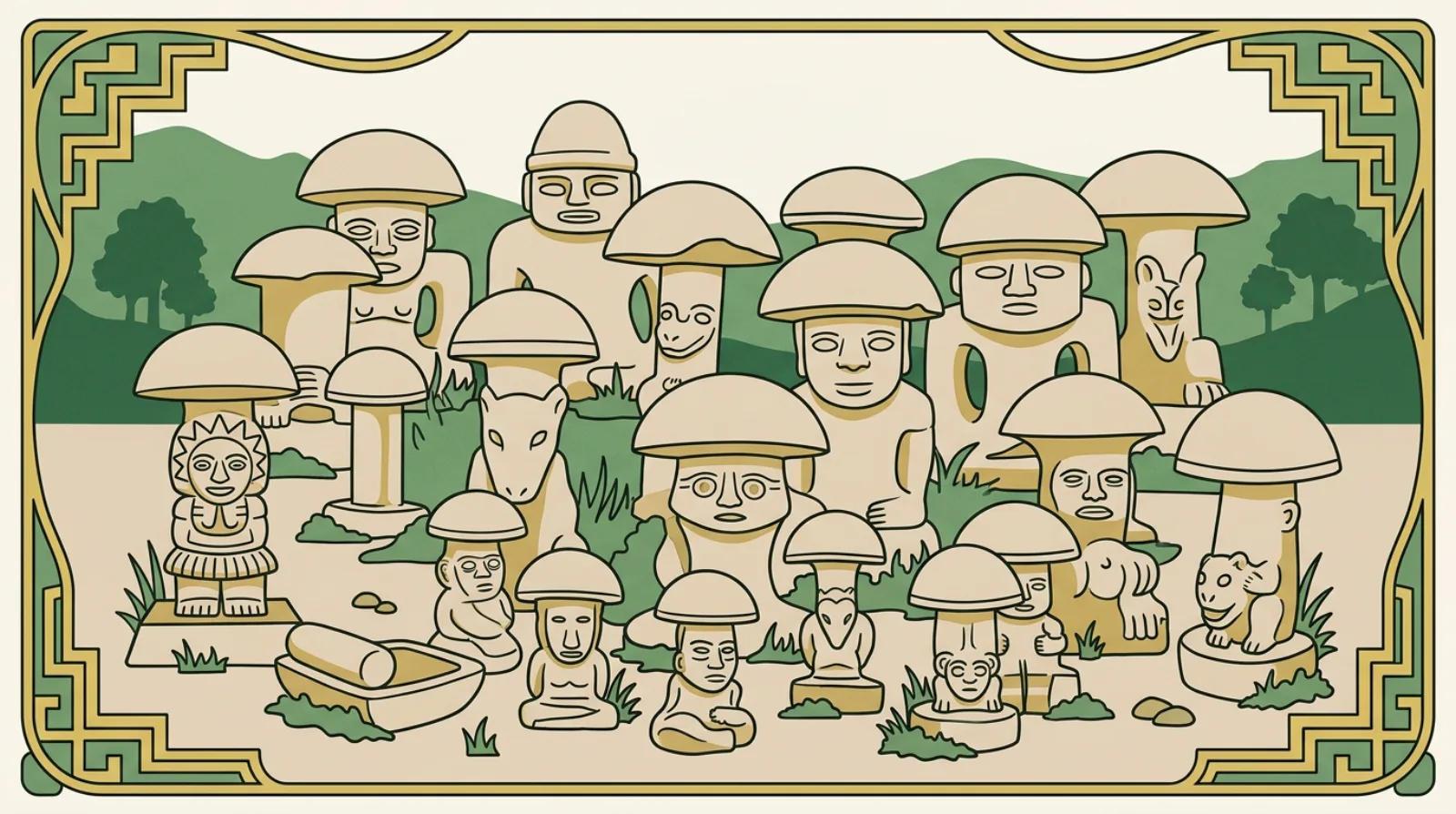
Photo: Maya mushroom stones. NIDA, public domain, via Wikimedia Commons.
There are objects in museum collections in Guatemala City, Mexico City, Antigua, and a handful of North American and European museums that most visitors walk right past. They are small — usually between eight inches and a foot high — carved from volcanic stone, and shaped unmistakably like mushrooms. A thick stem, a flared cap, and often a human or animal figure worked into the base of the stem. Archaeologists have catalogued them at around fifty different sites across the highlands of Guatemala, southern Mexico, El Salvador, and Honduras, with many more held in museum and private collections. The oldest date to roughly 1000 BCE. The most recent date to around 500 CE.
They are called, straightforwardly, the mushroom stones. And they are the closest thing we have to physical evidence that the peoples who lived in the highlands of what is now Guatemala used psychoactive mushrooms ceremonially two and a half to three thousand years ago.
Before anything else, it matters to name who lived and lives in that part of the world. The highland valleys around what was Kaminaljuyú — the archaeological site that has yielded many of the mushroom stones — were home to ancestors of the people we now call the Kʼicheʼ, the Kaqchikel, the Tzʼutujil, the Poqomam, and the Mam, among others. All of these are living Maya peoples. Over six million Maya still live in Guatemala today. The mushroom stones are not the relics of a vanished civilization. They are part of an unbroken human presence on that land that continues in the present, and the modern descendants of the people who carved them are still here to have opinions about what gets said about their ancestors.
What the stones look like
The basic form is consistent across centuries. A cylindrical or slightly tapered stem rises from a flared base. A cap — sometimes rounded, sometimes hat-shaped — sits at the top. The overall silhouette looks like a mushroom to anyone who has ever picked one. On many of the stones, the base is worked into a sculpted figure: a human face, a crouched human body, a jaguar, a toad, an owl, or a grotesque being that is harder to identify.
Some stones are rough and plain. Others are finely worked. Some are small enough to hold in one hand; others are heavy enough that moving them required effort. They were often buried with the dead, which is a clue to their meaning but not a conclusive one — plenty of things get buried with the dead that have nothing to do with mushrooms.
What scholars have argued
Through the first half of the twentieth century, most Western archaeologists had no idea what the stones were. They called them “idols” or “phallic sculptures” or simply “ceremonial objects of unknown function.” The mushroom-shape interpretation was proposed but not taken seriously by most of the field.
The argument changed in the 1950s. The ethnomycologist R. Gordon Wasson, who had just participated in a Mazatec mushroom ceremony in Oaxaca and published about it in Life magazine, looked at photographs of the Guatemalan stones and said, essentially, those are mushrooms, and the culture that carved them must have used psychoactive mushrooms ceremonially. He proposed that the mushroom stones were evidence of a ceremonial mushroom cult that had existed in the Maya highlands for more than two thousand years, connected in spirit (though not in direct lineage) to the Mazatec tradition still living in Oaxaca.
Wasson’s argument persuaded some and did not persuade others. Those who agreed pointed to the obvious mushroom form, the association with burials, and the fact that living Mesoamerican peoples still used psychoactive mushrooms ceremonially. Those who disagreed pointed out that shape is not proof, that we have no surviving written account of mushroom use from the ancient Maya, and that the stones might equally well have been grave markers, status objects, game pieces, or objects whose purpose is simply lost to us.
The careful answer, held by most specialists today, is that the stones probably represent a ceremonial relationship with psychoactive mushrooms — the form is too consistent and too explicit to be accidental — but that we do not know what the ceremony was, who led it, what the mushroom meant in the theology of the people who carved it, or how the practice related to the broader religious system of highland Maya life. The stones are evidence of something. They are not evidence that the something was exactly the thing we are looking for.
What the stones don’t say
This is the important part, and it is the part most often skipped when the mushroom stones get pulled into the modern psychedelic story.
The stones don’t tell us what the ceremony looked like. They don’t tell us which species of mushroom was used — Psilocybe cubensis is not even native to Mesoamerica and was probably introduced later with cattle; the native species are Psilocybe mexicana, Psilocybe caerulescens, Psilocybe zapotecorum, and others. They don’t tell us whether the mushroom was consumed in solitude, in groups, by specialists only, or more widely. They don’t tell us what was said during the ceremony, what it was believed to do, or what the relationship between the human carver of the stone and the mushroom was understood to be.
None of the content of the ceremony survives. What survives is the form of the stones and the silence around them.
There is a temptation, every time a new piece of the psychedelic past surfaces, to fill the silence with whatever the modern movement needs the past to have been. To make the mushroom stones the proof of a “psychedelic civilization” that already knew everything modern neuroscience is now rediscovering. To treat them as an endorsement of contemporary practice. The stones do not endorse anything. They are what they are: small carved objects of volcanic rock, buried with the dead, made by people whose worldview we cannot enter, whose descendants are still alive and whose descendants’ perspectives on what the stones meant have not been adequately incorporated into most of the scholarly literature written about them.
What the living descendants have to say
This is the thin part of the record and the part that matters most.
Modern Maya communities in highland Guatemala — especially communities in the departments of Alta Verapaz, Baja Verapaz, San Marcos, and Sololá — have their own ongoing spiritual and ceremonial traditions. Some of those traditions include plant medicine. A handful of contemporary Maya religious practitioners (ajqʼijabʼ, or day-keepers) have spoken publicly about the mushroom stones and the broader question of ancient mushroom use. Most are cautious. Some acknowledge an inherited memory of ceremonial mushroom use, sometimes connected to healing, sometimes to divination. Others point out that the evangelization of the highlands, beginning with the Spanish conquest in the 1520s and continuing through centuries of Catholic and more recently Protestant missionary activity, has broken many threads of continuity with pre-contact ceremony. What survives today survived through hiding, adaptation, and code.
There is no definitive “Maya” position on the mushroom stones, because there is no single Maya people and no single voice for the twenty-two distinct Maya language groups alive in Guatemala today. The honest version is: the question of what the stones meant to the people who made them is partially a question their descendants can speak to, and partially a question that has genuinely been lost across the centuries, and the Western fascination with these objects has not always made space for the descendants to be asked.
What this means for the modern microdoser
None of this is going to change what is in your capsule tomorrow morning. The ancient Maya of the highlands are not guiding your practice the way the Mazatec elders Maria Sabina belonged to might be said to still guide a velada. The distance is too large. The ceremony is lost. What you do with a microdose in 2026 is a modern thing, and dressing it in ancient clothing is a form of borrowing that the actual living descendants of these civilizations are justifiably tired of.
But there is a reason the mushroom stones are worth knowing about. They are evidence that the relationship between humans and psilocybin mushrooms is not a recent discovery, is not a product of the 1960s counterculture, is not an invention of Silicon Valley, and is not a novelty of modern Western neuroscience. It is something people in this part of the world were carving out of volcanic rock three thousand years ago. Whatever it meant to them — and we do not know exactly what it meant to them — they thought it was important enough to make it durable. Important enough to bury it with their dead. Important enough to carve the mushroom as a mushroom, plainly, again and again, across a thousand years of their history.
The mushroom stones are a reminder that the modern practice is walking onto very old ground. You are not required to know the prayers of that ground. You are invited to remember that it is old.
Sources and Further Reading
- Wasson, R. G., & Wasson, V. P. (1957). Mushrooms, Russia and History. Pantheon Books.
- Borhegyi, S. F. de. (1961). “Miniature mushroom stones from Guatemala.” American Antiquity, 26(4), 498–504.
- Guzmán, G., Allen, J. W., & Gartz, J. (1998). “A Worldwide Geographical Distribution of the Neurotropic Fungi, an Analysis and Discussion.” Annali del Museo Civico di Rovereto, 14, 189–280.
- Rubel, A. J., & Gettelfinger-Krejci, J. (1976). “The use of hallucinogenic mushrooms for diagnostic purposes among some highland Chinantecs.” Economic Botany, 30(3), 235–248.
- Lowy, B. (1971). “New Records of Mushroom Stones from Guatemala.” Mycologia, 63(5), 983–993.
- Carod-Artal, F. J. (2015). “Hallucinogenic drugs in pre-Columbian Mesoamerican cultures.” Neurología, 30(1), 42–49.
Related on The Microdose Movement
- Teonanácatl: The Nahua Name for the Sacred Mushroom — the written record from central Mexico
- Maria Sabina and the Sacred Children of the Mountain — the Mazatec curandera whose ceremony survived in Oaxaca
- Indigenous Wisdom and the Modern Practice — what we owe the people who kept this alive
The Microdose Movement is an educational community, not a medical provider. Nothing in this article is medical advice. This piece is written with respect for the living Maya peoples of Mesoamerica and with acknowledgement that much of what the mushroom stones meant to their makers has been lost or remains held by communities whose voices have not been adequately centered in the scholarly literature.
