
Maria Sabina and the Sacred Children of the Mountain
The story of Maria Sabina, the Mazatec curandera who shared the sacred mushroom with the modern world — what she taught, what happened next, and what her tradition asks of us in return.
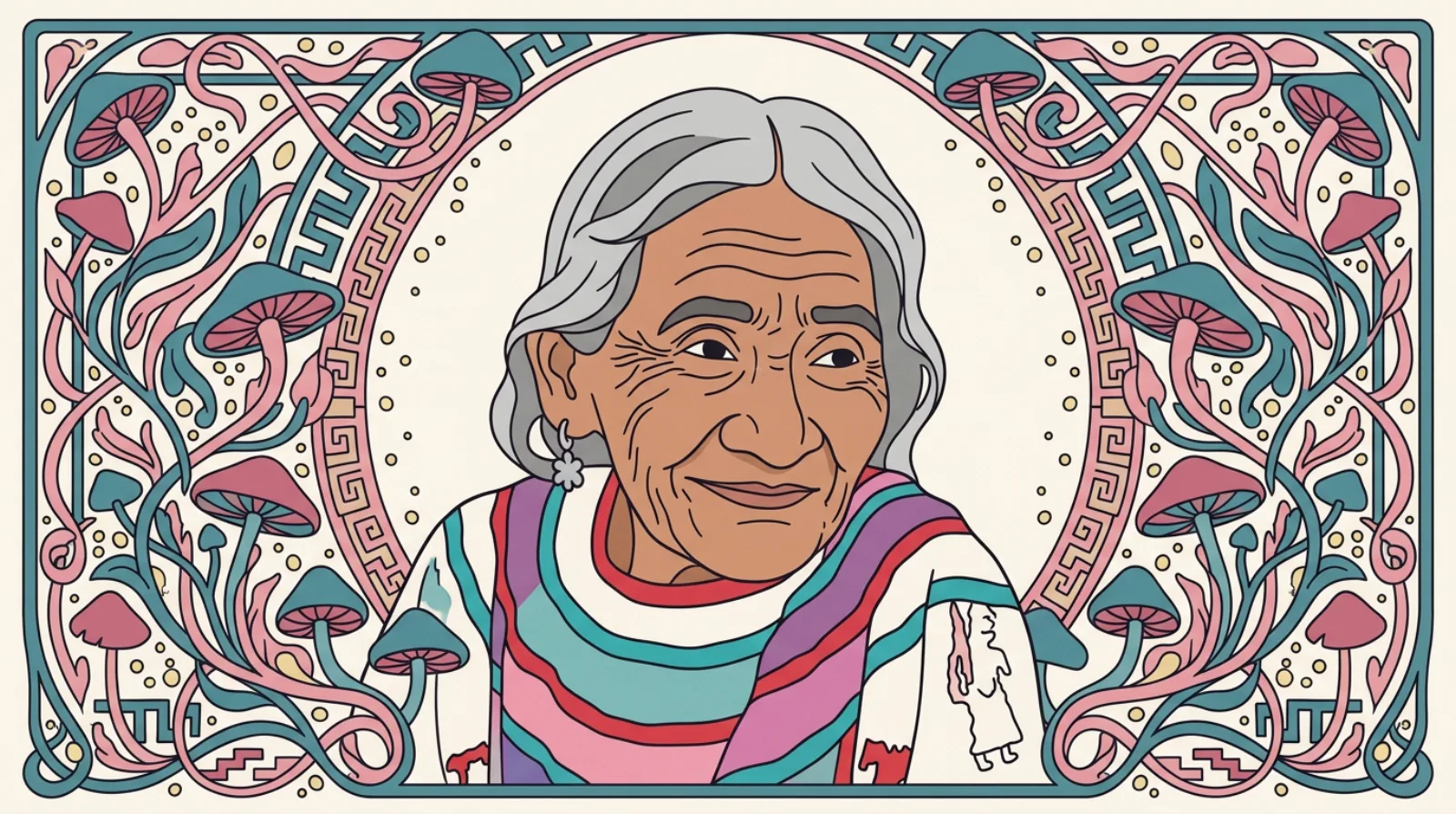
Photo: María Sabina, c. 1969. CC0 via Wikimedia Commons.
There is no honest history of psilocybin that does not begin with Maria Sabina. She is the reason most of the world knows what these mushrooms are. She is also a cautionary tale about what happens when sacred knowledge gets pulled out of its context and handed to people who do not understand what they are receiving.
This is her story, briefly and honestly. It is a story of generosity, ceremony, betrayal, and a medicine that was never supposed to leave the mountain.
Who Maria Sabina was
Maria Sabina was born around 1894 in Huautla de Jiménez, a small mountain town in the Sierra Mazateca of Oaxaca, Mexico. She came from a Mazatec family with a long lineage of curanderos — healers who used plants, prayer, and ceremony to treat the sick. As a young child she had her first encounter with the mushrooms her people called Los Niños Santos, the Holy Children, and she described it later as the moment she understood what her life was for.
By adulthood she was one of the most respected curanderas in the region. She conducted ceremonies called veladas — all-night healing rituals in which the curandera and the seekers consumed the mushrooms together by candlelight. Maria Sabina would sing for hours, her voice and the mushrooms together becoming the medium through which she diagnosed and healed. Her ceremonies were not performances. They were sacred work that her community had relied on for generations.
The Mazatec people did not call the mushrooms a drug. They called them children. They were treated as living beings with their own intelligence, deserving of respect and care, brought out only when there was real work to do.
The arrival of R. Gordon Wasson
In 1955, an American banker named R. Gordon Wasson traveled to Huautla with his wife Valentina, a physician. Wasson was a passionate amateur ethnomycologist — a student of human relationships with mushrooms — and he had heard rumors of a Mexican village where indigenous people used psilocybin mushrooms in religious ceremony. He wanted to participate in one.
Maria Sabina agreed to include him in a velada. She did so under the explicit condition that he was coming as a seeker who needed healing, not as a researcher or a tourist. The Mazatec tradition was clear: the mushrooms were not to be consumed for entertainment or curiosity. They were medicine. They had work to do.
Wasson participated in the ceremony. He was profoundly affected by it. And then he did something Maria Sabina had not anticipated. In May 1957, Wasson published an article in Life magazine titled “Seeking the Magic Mushroom” in which he described the velada in detail and identified Maria Sabina by name.
The article reached an audience of millions. Within months, Huautla was overrun.
What happened to Maria Sabina after the article
Tourists, journalists, hippies, and seekers started showing up in the small mountain town in numbers nobody was prepared for. Some came hoping to participate in a velada. Others came to find their own mushrooms and consume them recreationally. Still others came to get high and party. They brought drugs, alcohol, and a kind of cultural disruption the village had no defense against.
Maria Sabina herself paid an enormous price. The Mazatec community, watching the consequences of her sharing the ceremony with an outsider, partly turned against her. Her house was burned down. One of her sons was killed. Local authorities harassed her. She was arrested more than once for practicing ceremony.
In her final years she said that since the foreigners had come, the mushrooms had lost their meaning. The medicine that had been part of a sacred relationship had been turned into a commodity, a curiosity, a recreational substance. She felt she had been stripped of her gift.
She died in 1985, still living in poverty, still in Huautla. She never personally profited from the global wave of interest she had inadvertently launched. Her name became famous; her community got nothing.
What the Mazatec tradition actually taught
The veladas were not psychedelic experiences in the modern sense. They were structured ceremonies with specific elements. Among them:
- Ritual cleanliness. Participants prepared in advance — abstaining from certain foods, alcohol, and sexual activity for days before a ceremony.
- Set, setting, and intention. The work was done at night, by candlelight, in a sacred space. Every participant had to come with a specific question or wound they were bringing to the medicine.
- The curandera as guide. The ceremony was held by someone who had spent decades learning the relationship with the mushrooms. The seeker did not run the experience. The curandera did.
- Singing as medicine. Maria Sabina’s chants were not background music. They were the structural element of the ceremony. The voice of the curandera carried the medicine through the night.
- Integration. The day after a velada, the curandera would talk with the seeker about what had come up and what to do with it. There was no expectation that the experience would resolve anything by itself.
This is a different model from the modern recreational dose. It is also a different model from the modern clinical trial. It is closer to what good psychedelic-assisted therapy is trying to recover: the recognition that the medicine is not the whole thing, and that what surrounds the medicine matters as much as the molecule itself.
What her tradition asks of us
The Mazatec elders who came after Maria Sabina have been clear about a few things. They are worth knowing if you are going to engage with this medicine.
1. Acknowledge where it came from. Psilocybin did not come from a research lab. It came from a tradition that stewarded this knowledge for centuries before any scientist isolated the molecule. Naming that history is part of what it means to engage honestly.
2. Treat the medicine with respect. The Mazatec word for the mushrooms is Niños Santos — Holy Children. Whatever your spiritual orientation, the basic stance the tradition asks of you is that you are receiving something, not consuming a product. The way you treat the dose is the way you treat the relationship.
3. Do the work. The ceremony was never the whole thing. Integration, intention, preparation, and what you did the day after were as much part of the medicine as the dose itself. The same is true of any modern microdosing practice.
4. Don’t extract. A growing concern in the modern psychedelic movement is the extraction of indigenous knowledge — taking the practices, the molecules, and the marketing language without sending anything back to the communities that kept this alive. There are organizations doing reciprocity work in Mazatec country and other traditional psychedelic territories. Supporting them is one concrete way to participate in the history rather than just inherit it. The Indigenous Reciprocity Initiative and the work of the Chacruna Institute are starting points.
What this means for the modern microdoser
Most people who pick up a microdose today will never sit in a velada. That is okay. The Mazatec tradition is not the only way to engage with this medicine, and the modern context calls for different containers.
But the inherited posture matters. Approaching the dose with respect, with intention, with the willingness to do the work that comes after — these are not optional add-ons to the practice. They are the practice. Maria Sabina would have recognized them. The fact that she had to fight to preserve them, and lost more than she ever gained from sharing them, is a lesson worth carrying every time you sit down with a dose.
Sources and Further Reading
- Wasson, R. G. (1957). “Seeking the Magic Mushroom.” Life Magazine, May 13, 1957.
- Estrada, A. (1981). Maria Sabina: Her Life and Chants. Ross-Erikson.
- Feinberg, B. (2003). The Devil’s Book of Culture: History, Mushrooms, and Caves in Southern Mexico. University of Texas Press.
- Schultes, R. E., & Hofmann, A. (1979). Plants of the Gods: Origins of Hallucinogenic Use. McGraw-Hill.
- MAPS Bulletin: Maria Sabina and the Mushrooms
Related on The Microdose Movement
- Indigenous Wisdom and the Modern Practice — what we owe the traditions that came before us
- A Brief History of Microdosing — the long story of human relationship with these mushrooms
- The Origin Story: Why I Built This — the founder’s first-person account
The Microdose Movement is an educational community, not a medical provider. Nothing in this article is medical advice.
