
Indigenous Wisdom and the Modern Practice: What We Owe the People Who Came Before
An honest look at what the modern microdosing practice owes to the indigenous traditions that kept this knowledge alive — and how to engage with the medicine without extracting from it.
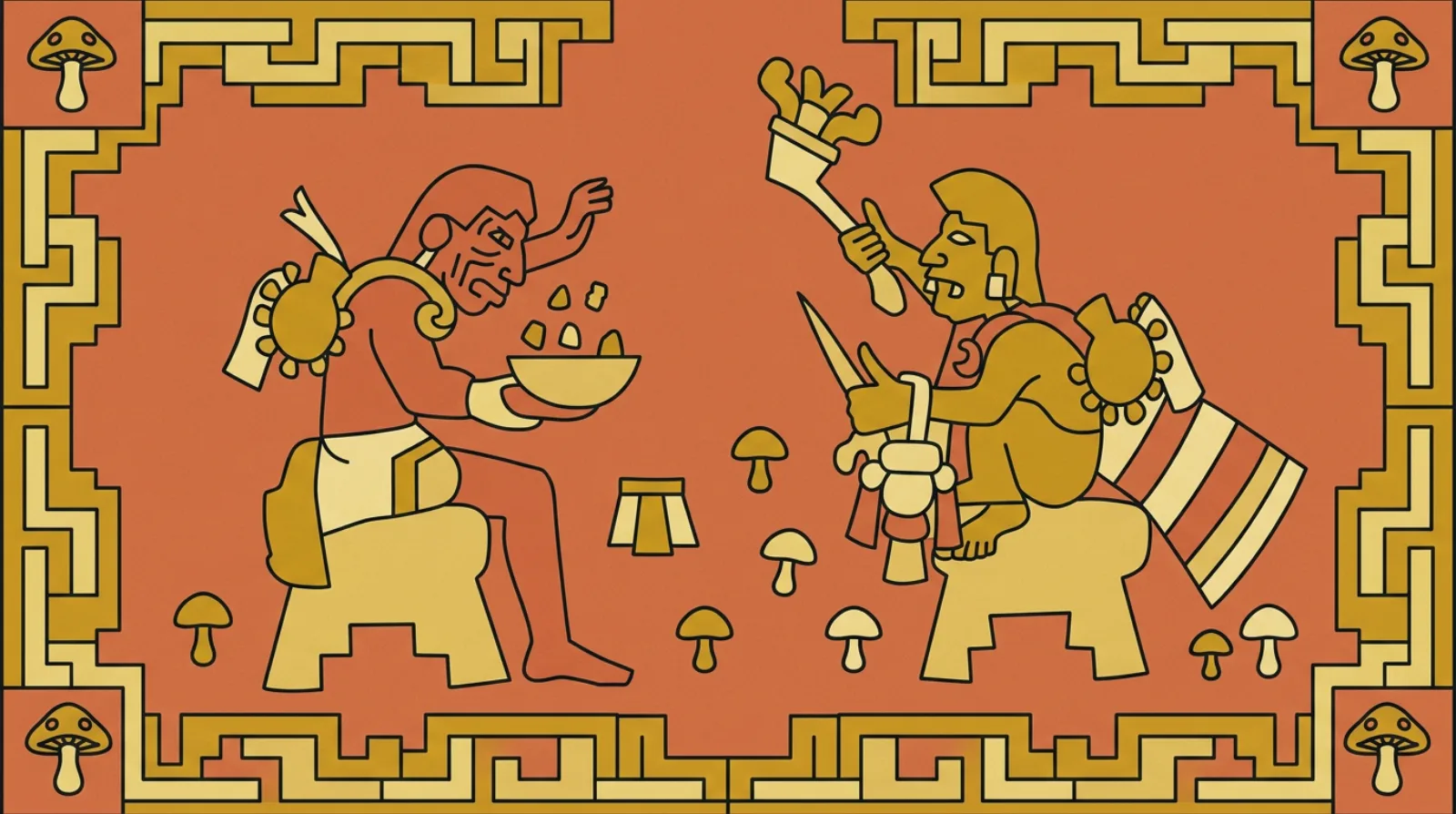
Photo: Cloud forest of Santiago Comaltepec, Oaxaca. Prsjl, CC BY-SA 3.0, via Wikimedia Commons.
You can use psilocybin without ever thinking about where it came from. The capsule arrives, the dose is taken, the body responds, and the practice becomes a private thing between you and your own mind. This is how most of the modern microdosing world works. It is not exactly wrong, but it is incomplete.
The mushrooms you are holding came from somewhere. The protocols you are following are descendants of something older. The very fact that you can buy them, talk about them, and search the internet for information about them is the result of a chain of events that includes specific people in specific places who carried this knowledge through times when the world wanted to make it disappear. Engaging honestly with the medicine means engaging honestly with that chain.
This article is about what the modern practice owes to the indigenous traditions that came before, what extraction looks like, what reciprocity could look like, and how to think about all of this without either ignoring the question or performing your awareness of it.
The traditions that came before
Psilocybin mushrooms have been part of human ceremony for at least 3,000 years on the American continents alone. The traditions that are best documented are Mesoamerican, but they are not the only ones. Several indigenous cultures developed sophisticated relationships with psychedelic fungi independently of each other and continued those relationships across many centuries.
A few of the traditions worth knowing about:
The Mazatec people of Oaxaca, Mexico. The Mazatec relationship with psilocybin mushrooms is the most thoroughly documented surviving indigenous psychedelic tradition. The mushrooms are called Niños Santos (Holy Children) or Los Pequeños (the Little Ones), and they have been used in healing ceremonies called veladas for many generations. Maria Sabina, the Mazatec curandera who shared a velada with R. Gordon Wasson in 1955, is the best-known representative of this tradition, but she was one of many curanderas working in the same lineage.
The Mixtec, Zapotec, and Nahua peoples of central Mexico. These groups also used psilocybin mushrooms ceremonially before the Spanish conquest. The Aztecs called the mushrooms teonanácatl, meaning “flesh of the gods.” Sixteenth-century Spanish records describe ceremonial use among indigenous communities throughout central Mexico, and archaeological evidence in the form of mushroom-shaped statuettes from the Maya region of Guatemala suggests psilocybin use throughout the broader Mesoamerican cultural sphere.
Possible African and Saharan uses. Rock art in the Tassili region of Algeria, dated to around 7000 BCE, depicts figures that some researchers interpret as showing humans consuming mushrooms. The interpretation is contested but the imagery is real. If correct, it would push human ceremonial use of psilocybin back into the deep prehistory of North Africa.
The Kogi people of Colombia and other Andean traditions. Several South American indigenous groups developed sophisticated relationships with various psychoactive plants and fungi. The most famous of these — ayahuasca, traditionally used by Amazonian tribes — is a different compound, but the broader posture of treating psychoactive medicines as sacred relatives, not consumer products, is shared across these cultures.
Other regional traditions. Documented and undocumented indigenous use of psychoactive fungi has been recorded in parts of Siberia (with Amanita muscaria rather than Psilocybe), in scattered locations in Australia and Papua New Guinea, and elsewhere. The full picture is incomplete because so much of this knowledge was suppressed, lost, or never written down by the cultures themselves.
The point is not that psilocybin belongs to any one of these traditions exclusively. It is that the human relationship with these mushrooms has been ongoing in many places for a very long time, and the modern microdosing practice is the latest chapter in that relationship, not the first.
What extraction looks like
The word “extraction” gets used in psychedelic ethics conversations to describe a specific pattern: the modern world taking knowledge, plants, practices, or molecules from indigenous communities without reciprocity, attribution, or care for the consequences for those communities.
It is not always intentional. Most of it is structural. But it is real, and it has consequences. Some examples of what extraction looks like in the psychedelic context:
-
Taking the molecule and forgetting the relationship. Psilocybin was isolated by Albert Hofmann in 1959, after Wasson sent him samples from Maria Sabina’s tradition. The molecule entered Western pharmacology. The tradition that produced it received nothing in return. Most people who take a psilocybin capsule today have never heard of Maria Sabina.
-
Tourism that disrupts the source community. When Wasson published his article in Life magazine in 1957, he turned Huautla de Jiménez into a destination for Western seekers. Thousands of people descended on the town with no understanding of local customs, no respect for the ceremony, and no contribution to the community. Maria Sabina’s house was burned. Her son was killed. The local culture was destabilized in ways that took decades to begin to recover.
-
Commercial branding that aestheticizes indigenous traditions. Modern psychedelic companies frequently use indigenous imagery, language, and aesthetics in their marketing — feathers, drums, spirit-guide language, sacred-ceremony framing — without any actual relationship with the traditions they are referencing. The visual language of indigenous spirituality becomes a marketing asset for a product the indigenous communities receive no benefit from.
-
Selective borrowing. Western psychedelic frameworks often pick up the parts of indigenous practice that translate easily — set, setting, intention, integration — while leaving out the parts that don’t fit a consumer model: the long apprenticeship of the curandero, the obligations to the community, the spiritual responsibilities, the absence of profit motive.
-
Patenting and pharmaceutical capture. A growing concern in 2024–2026 is that pharmaceutical companies are filing patents on psilocybin formulations and delivery methods, effectively converting an open ancestral medicine into proprietary intellectual property. This is the formal legal mechanism by which extraction becomes permanent.
None of this is unique to psychedelics. It is part of a much longer history of how dominant cultures have related to indigenous knowledge: take what is useful, ignore what is inconvenient, give nothing back. Knowing the pattern is the first step toward not participating in it.
What reciprocity could look like
The opposite of extraction is reciprocity — the practice of sending something back to the communities whose knowledge made the modern conversation possible. There is no single right way to do this, but several real options exist for anyone who wants their engagement with the medicine to include some form of acknowledgment.
Donate to indigenous reciprocity organizations. The Indigenous Reciprocity Initiative of the Americas channels funds from the modern psychedelic community to indigenous-led projects in the source communities. The Chacruna Institute does similar work and produces educational material on cultural ethics in psychedelic practice. These are the most direct ways to participate in reciprocity.
Learn the history. Reading the actual history of how these compounds came to be available in the modern world is itself a form of acknowledgment. Most of the books and articles in the history of microdosing and Maria Sabina pieces on this site are good starting points. The history is not boring. It is the context that makes the practice meaningful.
Use the original names. When speaking about the mushrooms, the Mazatec called them Niños Santos — Holy Children — and treated them as living beings, not commodities. You do not have to adopt this language religiously, but using it occasionally, in the way Maria Sabina would have used it, is a small gesture that keeps the original relationship in the room.
Refuse to participate in extraction. Choose brands and practitioners that are transparent about their sourcing, that acknowledge indigenous traditions in a substantive way, and that are not building businesses on the assumption that the source communities should be silent partners. The Microdose Movement is built around this principle, and we are not the only ones.
Treat the medicine with respect. This is the simplest and most consistent form of acknowledgment. The Mazatec tradition treats psilocybin as a sacred relative, not a consumer product. The way you treat the dose is itself a form of relationship with the lineage. Approaching it with intention, with care, with the willingness to do the work that comes after — these are not optional add-ons. They are the practice.
What this looks like in modern context
Most people reading this will not sit in a velada. Most will not travel to Oaxaca. Most will not develop personal relationships with curanderos. The realistic question is what reciprocity looks like for someone who is microdosing in their kitchen on a Tuesday morning.
A few things to consider.
The dose is part of a relationship. Even if you are taking a microdose alone in your apartment, you are participating in the ongoing relationship between humans and these mushrooms that has been continuous for thousands of years. Treating the dose as something more than a supplement — as part of a practice with depth and history — is the smallest version of the larger acknowledgment.
The Movement community is one container. Joining a community where these conversations are taken seriously, where the history is named, where the indigenous traditions are honored, is part of how the practice stays connected to its roots. The Microdose Movement community is one place where this happens, and there are others.
Your money is a vote. Where you spend money on psychedelic-related products, education, and experiences sends signals about what kind of psychedelic culture you want to exist. Buying from extractive brands trains the market to be extractive. Buying from brands that practice reciprocity trains the market in the other direction.
The work itself is the central thing. None of the gestures above matter as much as actually doing the work the medicine asks of you. Integration. Honesty. The willingness to be changed. These are what every indigenous tradition with a relationship to these compounds has emphasized first. They are also, not coincidentally, what most modern recreational use leaves out.
What we owe
You can summarize the whole thing in a few sentences.
We owe acknowledgment to the people who carried this knowledge through times when the world tried to make it disappear. We owe respect to the medicine itself, and to the relationship the source traditions modeled. We owe care in how we talk about these compounds, how we use them, and how we build the communities and businesses that are growing up around them in the modern era.
We owe more than the modern psychedelic industry has so far paid. The bill is still mostly unpaid. The Microdose Movement is one attempt to begin paying it — by naming the lineage, by linking out to reciprocity organizations, by refusing to use the visual language of indigenous spirituality as a marketing asset, and by holding the principle that the medicine is a relative and not a commodity. It is a small contribution. There is much more to do.
Limitless by nature, but never alone. The lineage is the company we are keeping.
Sources and Further Reading
- Estrada, A. (1981). Maria Sabina: Her Life and Chants. Ross-Erikson.
- Schultes, R. E., & Hofmann, A. (1979). Plants of the Gods: Origins of Hallucinogenic Use. McGraw-Hill.
- Labate, B. C., & Cavnar, C. (Eds.). (2018). Plant Medicines, Healing and Psychedelic Science: Cultural Perspectives. Springer.
- Gerber, K., et al. (2021). “Ethical concerns about psilocybin intellectual property.” ACS Pharmacology & Translational Science, 4(2), 573–577.
- Chacruna Institute — psychedelic medicine and cultural perspectives
- Indigenous Reciprocity Initiative of the Americas — direct reciprocity work
Related on The Microdose Movement
- Maria Sabina and the Sacred Children of the Mountain
- A Brief History of Microdosing
- The Suppressed Decade: How Modern Research Got Erased
- The Origin Story: Why I Built This
The Microdose Movement is an educational community, not a medical provider. Nothing in this article is medical advice.
